




























Views
Downloads


Skip Counting by 4s, 5s, 10s | Grade 1 Printable Worksheet

Paste this activity's link or code into your existing LMS (Google Classroom, Canvas, Teams, Schoology, Moodle, etc.).
Students can open and work on the activity right away, with no student login required.
You'll still be able to track student progress and results from your teacher account.
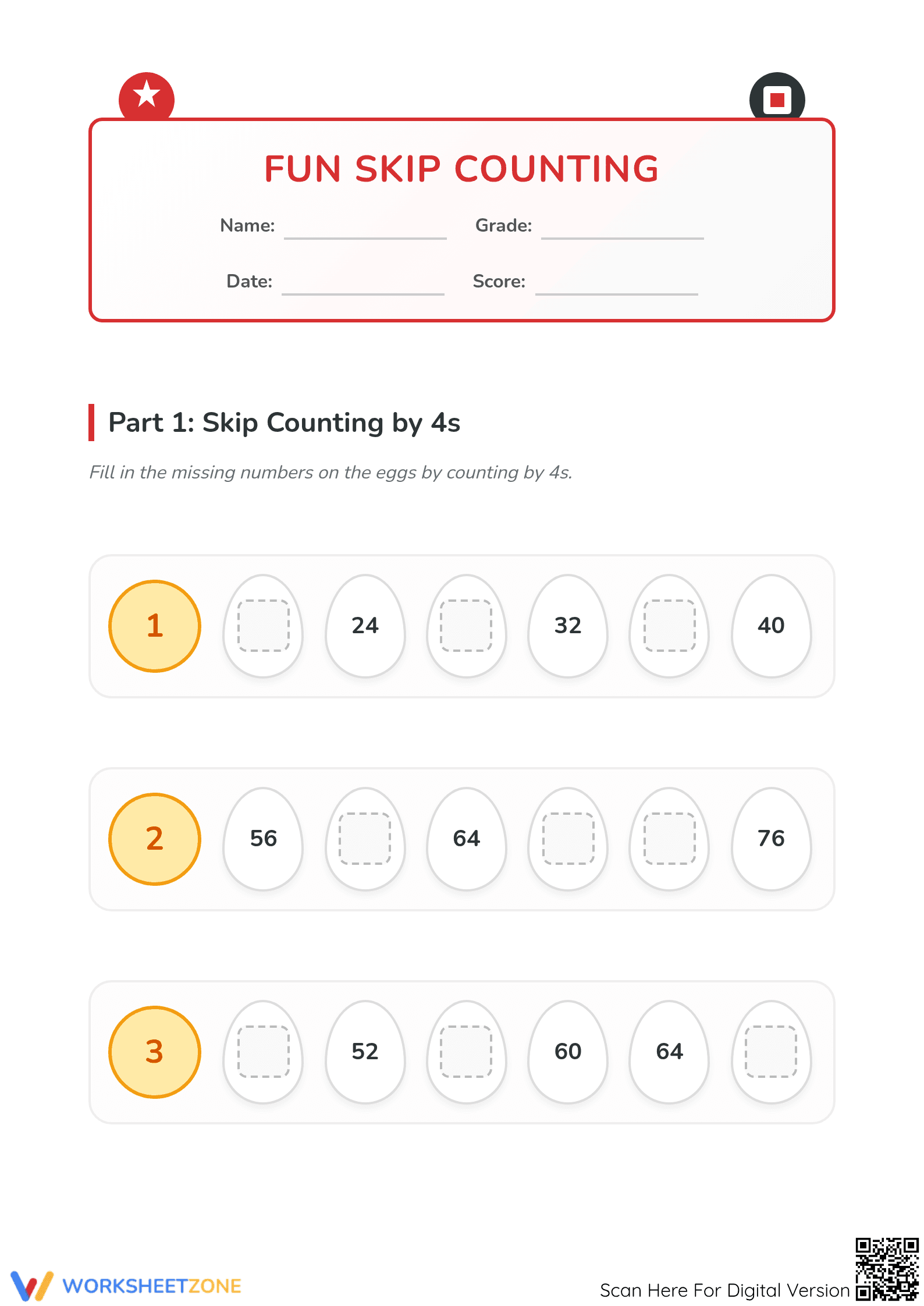
This skip counting worksheet helps Grade 1 students master numerical sequences by counting in intervals of 4, 5, and 10. By filling in missing numbers on egg-shaped graphics, learners build the fluency required for arithmetic. The structured format ensures students transition from basic recognition to identifying rhythmic patterns within the base-ten system.
At a Glance
- Grade: 1 · Subject: Math
- Standard:
CCSS.MATH.CONTENT.1.NBT.A.1— Count to 120, read and write numerals, and identify number patterns- Skill Focus: Skip counting by 4s, 5s, and 10s
- Format: 3 pages · 9 problems · Answer key included · PDF
- Best For: Morning work or small group math
- Time: 15–20 minutes
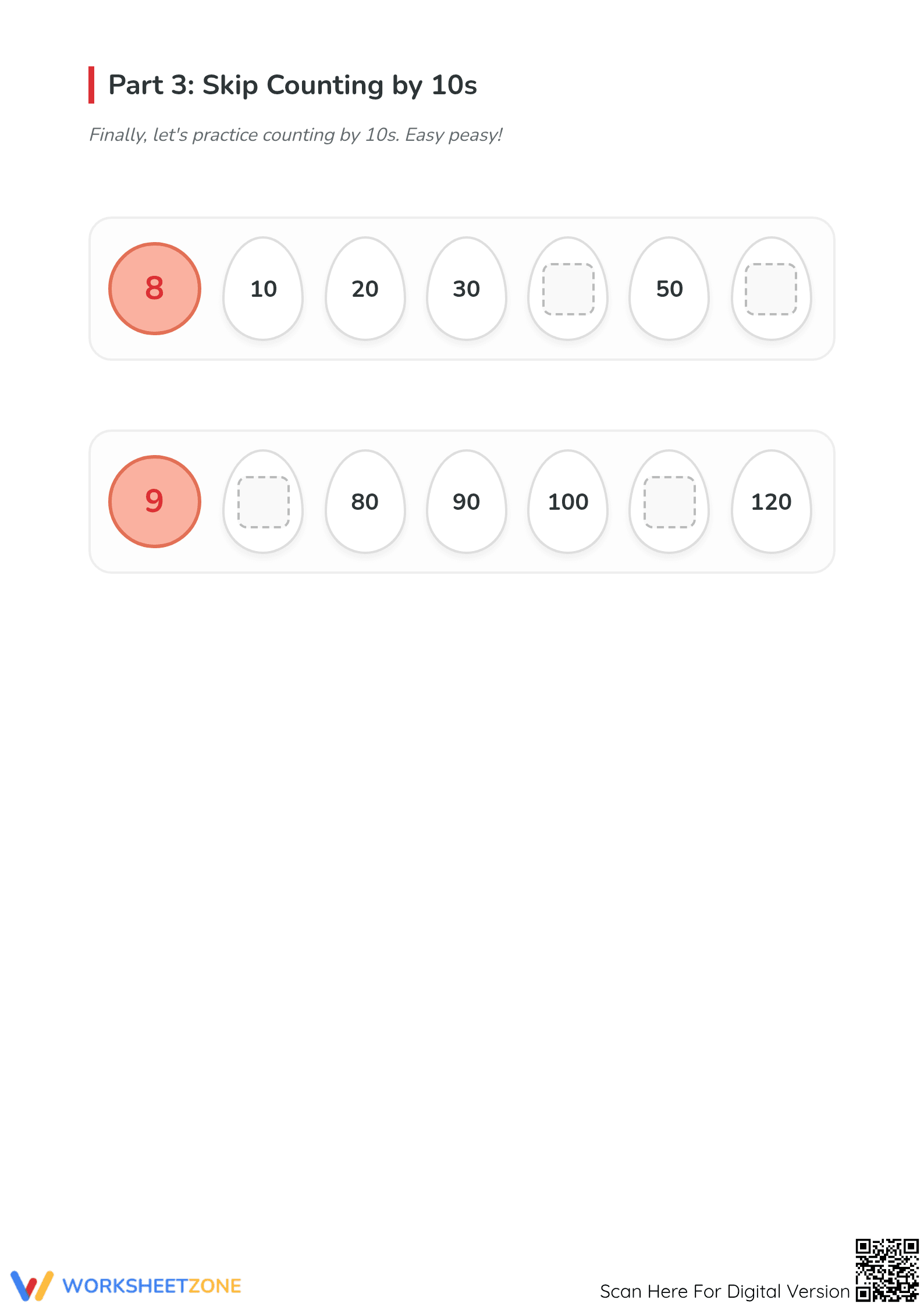
This three-page PDF resource provides comprehensive practice in number sequencing. Part 1 focuses on skip counting by 4s across four task rows. Part 2 introduces intervals of 5 with three additional rows, while Part 3 concludes with two rows of skip counting by 10s. A full answer key is included to facilitate rapid teacher or student self-grading.
- Guided practice: The initial rows provide consistent numerical anchors, requiring students to fill in only three missing numbers per sequence to establish the pattern.
- Supported practice: Middle tasks increase cognitive demand by spacing out prompts, forcing students to apply mental math strategies to continue the count.
- Independent practice: The concluding tasks in each section offer minimal scaffolding, challenging learners to complete the entire sequence with limited starting points.
This sequence follows a gradual-release model, incorporating I Do, We Do, You Do instructional strategies.
Aligned to CCSS.MATH.CONTENT.1.NBT.A.1: "Count to 120, starting at any number less than 120. In this range, read and write numerals and represent a number of objects with a written numeral." This worksheet specifically targets reading and writing numerals within various sequences. Standard codes can be copied directly into lesson plans, IEP goals, or district curriculum mapping tools.
Use this during the "We Do" phase of a lesson to model rhythmic counting patterns. Alternatively, assign it as a formative assessment to observe which students struggle with the transition between numerical sets. Completion time typically ranges from 15 to 25 minutes. This resource effectively bridges the gap between oral counting and written numerical representation.
Designed for Grade 1 students or advanced Kindergarteners. It serves as an ideal resource for RTI groups or as a supplement to a primary curriculum passage on number sense. The visual clarity makes it accessible for English Language Learners who are developing mathematical vocabulary alongside their numerical fluency.
Research by Fisher & Frey (2014) highlights that scaffolding number sequences through visual organizers—like the eggs used here—significantly improves the retention of skip counting patterns. By targeting CCSS.MATH.CONTENT.1.NBT.A.1, this worksheet helps students internalize the structure of the number system. This skill, specifically skip counting by 4s, 5s, and 10s, is a foundational precursor to multiplication and division. The NAEP data suggests that early mastery of these patterns correlates with higher proficiency in middle-school algebraic thinking. Educators can utilize this 3-page printable to provide high-frequency practice that bridges the gap between rote counting and conceptual understanding. Each of the 9 tasks is designed to reinforce the rhythmic nature of math, ensuring students can read and write numerals accurately across different intervals. This resource provides a proven method for building the mathematical stamina required for Grade 1 success.


